Showing posts with label sorghum. Show all posts

Tuesday, December 22, 2015

Grazing cover crops

There has been quite a bit of discussion about cover crops and dual purpose cover/forage crops for the past few years. Some of the seed blends can get quite costly, I've seen quotes as high as $60 an acre for some seed mixes, this was the price of seed wheat during the height of the high grain price cycle.

Since I still had sunflower seed in the planter boxes  I added some grain sorghum, corn, soybeans, and some more sunflower seed that was in the left over seed pile in the shop. All of this was seed that had been cleaned out of the planter so the cost of the seed was already paid for by the full season crop. This was planted on wheat stubble that was fallow until grain sorghum is planted next June, the seed was left over, part of the field was fertilized got the fertilizer that was left in the planter, so the only real expense was my time and wear and tear on the planter.
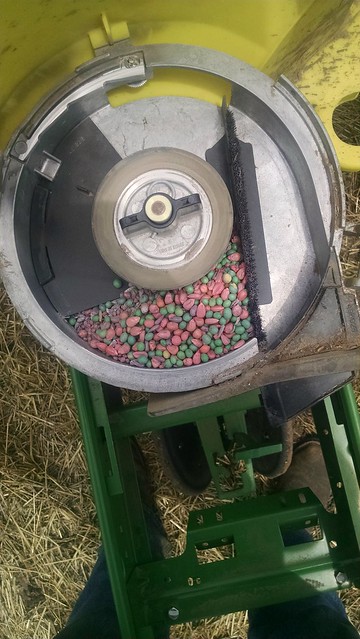
2015-12-21_12-14-50
The seed mix I planted. It's a mix of corn, soybeans, sunflowers, and grain sorghum. This is some seed that had been cleaned out of the planter the last couple of years.

I started with a seed population of 30,000 and decided to bump that to 40,000, for two reasons a, to see what it would do and b, I was getting tired of sitting in the tractor. I picked 30,000 because that is high for sunflowers, low for grain sorghum, high for corn, and extremely low for soybeans. I used the sunflower seed meter disk since they were the closest to medium size and played with the vacuum until I was satisfied with the seeding rate. I wasn't overly concerned with seeding accuracy due to the purpose of this crop.

I seeded this on July, 30th in a normal year nothing should have made it to full maturity. With the mild fall and late killing freeze the sunflowers did, but didn't retain seed and some shorter season corn did might of made it to physiological maturity. Both the sorghum and corn should have been high nutrient level in the plant at the time of a killing frost.
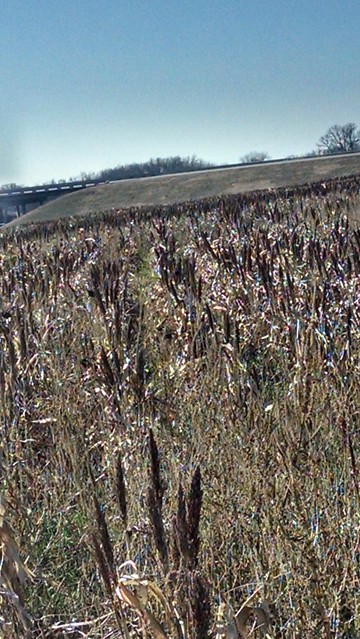
2015-12-20_11-55-01
Looking down the row, I ended up with more grain sorghum in the mix that I had originally planned. I didn't put any more bags in, but at about 15,000 seeds per pound when compared to the other seeds it makes sense.

I was surprised at the amount of volunteer wheat growing in it between the rows. Having it growing will extend the time that a root is actively growing. I feel root activity adds considerably to to soil health.
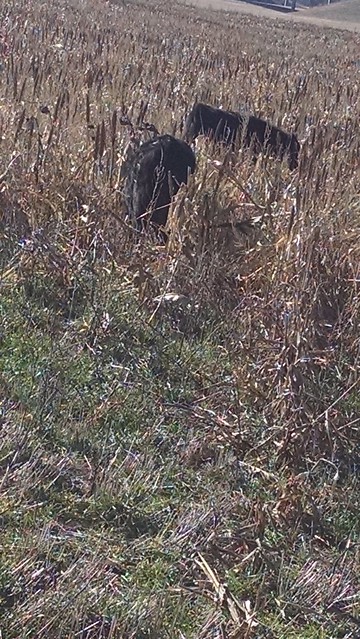
2015-12-20_11-55-41
Some calves grazing it. Those are sunflowers to the left of the calf in the foreground.
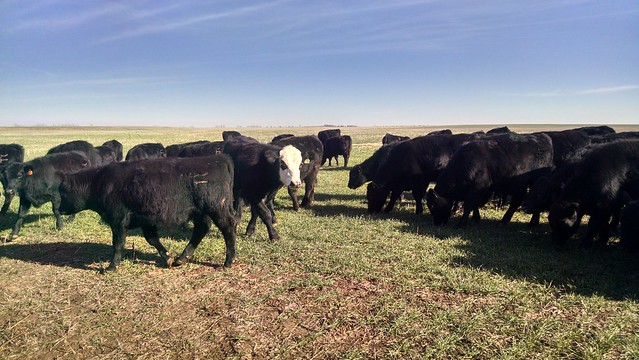
2015-12-20_11-54-10
To simplify the fencing I including part of the adjoining wheat field. Typically we don't pasture wheat, but it is an accepted practice for the area. The calves will be of before the wheat gets to the jointing stage this spring so there will be no permanent harm to the wheat.

I don't have access to scales to measure growth so I will track the amount of hay I feed compared to what I would have fed in a drylot. Normally we feed medium quality brome, priced at about $45 a bale.

In future years I will add a few turnips or radishes and Austrian winter peas. I think this will be an inexpensive way to add even more diversity. The turnips or radishes will have deep roots along with the sunflowers and will absorb nutrients and the peas will convert atmospheric nitrogen to usable nitrogen in the plant that will go into the soil after it decomposes. The peas might over winter, I haven't found a definitive answer, but even if they do it should be simple to kill out in the spring when I do spring burn down for the volunteer wheat.

Tuesday, March 3, 2015

Where our corn is going

Normally our corn is sold to a cattle feedlot to be used as an ingredient in cattle feed. This year it is going to an ethanol plant. This is the first time that we have delivered to an ethanol plant, some of the corn and grain sorghum that we have delivered to elevators might have gone to ethanol.

Loading corn bound for an ethanol plant.
I posted this picture to twitter, @ksfarmboy, today while loading our semi for the drive to Russell, Kansas.

Our grain prices have changed greatly in our area the past year. Typically in my area corn is priced twenty cents a bushel, 56 pounds per bushel of both corn and grain sorghum, more than sorghum. China started importing sorghum last year and has been aggressively importing it this year. This has driven the sorghum price locally to a over a dollar a bushel over corn, making corn a natural alternative for sorghum in many Kansas ethanol plants and for other end users of sorghum in the area.
The corn is being delivered to White Energy in Russell Kansas. This ethanol plant is combined with a wheat gluten plant and share many resources. To learn more about it the plant.


Thursday, November 21, 2013

Harvest update 13

We wrapped up soybean harvest and wheat seeding the end of October and moved on to corn and then grain sorghum harvest.

There were some mechanical setbacks with harvest, a nagging problems with a header during soybean harvest, the header is the front part that cuts the plant and brings them into the combine. I was seeding wheat, but they told me they usually had it repaired by the time of day that the soybeans were ready for harvest, most crops will take on moisture from dew or frost overnnight and will not harvest properly until late morning.

The combine we use for corn had a couple of major components fail that took quite a bit of time to repair. After that corn harvest was smooth sailing.

I tried harvesting grain sorghum while the rest of the crew harvested corn, but was only able to do a about a hundred acres due to high moisture content of the grain and having to utilize a couple of grain bins that have huge fans that can dry the grain to acceptable levels for storage.

I shifted my attention to helping with corn harvest since we were storing the rest of the crop on the farm for winter and spring delivery to cattle feedlots and feed mills. Our irrigated corn is very high quality that cattle feeders and feed mills recognize and will possibly pay premium. Also my area uses more corn than is raised locally.

The last field of corn harvested was one that was planted to drought tolerant hybrids on a field that has a slightly limited irrigation water available and considerable variation in soils, this can make getting enough water in the soil for the crop challenging particularly in hot dry and weather periods. Half of the field was planted to seed from Pioneer/DuPont gene marker assisted breeding and the other half utilized Monsanto's drought tolerant bio tech trait. The whole field averaged 170 bushel an acre which is very good for it. I was very pleased considering the non irrigated portion was planted with the same seeding and fertilizer rate as the irrigated part, ideally the non irrigation portion would be planted with 6,000 less seeds an acre and save a 1/4 or more on fertilizer.

irrigated corn in a pasture?
This is the field that was planted to the drought tolerant corn, it's along a creek with native pastures on all 4 sides. In the foreground is some of the native plants that are common on our virgin prairie.


Dryland corn
This is some of the dryland corn on that field, this happens to be from the Pioneer seed. The ears were smaller than the DeKalb corn, but very uniform and every plant had an ear except for what the deer ate.

Untitled
This is an ear of corn from the DeKalb seed on the dryland. It had kernels set on 20 rows, I've only seen a few ears of corn that was 20 row in my entire lif

After we finished corn that afternoon I cut a test sample of grain sorghum. I had heard from neighbors and elevator employees that they hadn't been any below 17% moisture. I was surprised the sample was 15.6% moisture, so I went back and cut a semi load, that load was 15.3% moisture and has been the highest moisture since then. Grain sorghum over 15% is discounted and higher moisture levels get discounted at higher rates. The yield has been very goood and test weights higher than I expected considering the cool spell during August, the truck drivers have reported test weights up to 62 pounds a bushel, the standard is 56 pounds a bushel. Plants have gone down in places in fields, this is another problem we face with growing it. I tried a new sorghum from Pioneer/DuPont and was very pleased with it, generally there isn't new sorghum seed released so getting a new hybrid to plant is exciting.

I feel we are moving into a more normal weather pattern and with my limited experience with drought tolerant corn it will be a viable option than grain sorghum and will allow me to better maximize my labor. Many times dryland corn is ready for harvest during a slow time in September between irrigation and the beginning of wheat seeding and soybean harvest when we have more hours of daylight. I've gotten lucky this year with sorghum drying down in the field as it has, normally it won't we have to take the discounts. Freeing up time and labor now would allow time to expand our cattle enterprise and to be more timely with the management. 

On of my seed dealers that also farms has experimented with planting corn lato, I assume mid June. He left a portion of a sorghum field and then planted corn. I think this is the second or third year of experimenting with this and was very successful this year. He mentioned that he might try late planting corn on one of his better dryland fields. The reason for the experiment was to try to time the corn's water needs to the typical rain pattern of August, these are the rains that help our sorghum produce the yields it does.

Monday, January 21, 2013

2012 year in review

I can't believe half of January has already passed. I had been wanting to do some kind of a 2012 wrap up and couldn't think of anything until after I uploaded photos to my flickr account. I have a decent amount of photos uploaded from over the past few years, many of the photos have descriptions of what is taking place. It dawned on me I could pick and choose various photos from through out the year, I wasn't as camera happy as in the past partially because much of it will not vary a great deal from year to year.

x2_bcba1a8
We have a small herd of spring calving cows. I was surprised at how many we had the first month, 80%. Then calving slowed to a crawl. I think the heat during the summer before combined with them raising their first calf and were still growing may have had some influence on it. This happens to be the only white faced calf born this year.

009
I spent a good portion of my spring seeding corn, sunflowers, soybeans and grain sorghum. I didn't have a picture of planting this year so I used this one from my archives.

040
Wheat harvest came unusually early this year, but this yields were respectable considering the weather turned hot and dry during grain fill. We started harvest the end of May, where normally we may start June 17th. As what normally happens I spent the first few days finishing sorghum planting. We had started planting early this year and I finished planting this year earlier and finished earlier than normal.

IMG-20120608-00178
The bare strip is from having half the planter turned off while planting sorghum the previous year. Soybeans struggled to sprout and grow here until after a good rain. I was surprised while checking planting depth during planting that we actually had some soil moisture in the planting zone where there was even a minimal amount of residue covering the soil.

first irrigation
This how I spent most of wheat harvest and the rest of the summer irrigating corn and soybeans. We had replaced an irrigation system last spring and this is the first irrigation pass with it.

Bulgarian farmers

On June 16th we had a group of farmers from Bulgaria visit the farm. It was an interesting visit, once they became comfortable with us the ones that could speak English visited with us. They were interested in how we raise Sunflowers, but farmers will be farmers no matter where they are from the conversation turned to farming practices in general and all the crops we raise. This is the only photo I took was this one of them looking over my dad's older Corvette. The International Grains Program at Kansas State University coordinated the tour.

x2_d589172
We did our normal double crop planting of soybeans and sunflowers this summer after wheat harvest. We planted more double crop soybeans this past summer than previously and less sunflowers.

Fall cow calf pair 1
We acquired a few fall calving cows last spring. They had started calving a couple of weeks earlier than expected. These cows came from Harms Plainview Ranch so they should genetically exceed most commercial cows.

Wheat seeding visitors
This fall during wheat seeding we had a group of wheat flour millers from Japan visit. They were interested in hard white wheat and how we raise it. My dad is explaining to them how the drill puts seed and fertilizer in the soil in this picture. This was also coordinated with International Grains Program at Kansas State University and
Farmer Direct Foods was also involved. My mom is a heckuva a home baker and made a loaf of bread with both red, the more common breadwheat, and white twisted together which gave them a comparison of the two types of bread.

milo2012
Milo, also known as grain sorghum, harvest was fair to good, I experimented with more hybrids this year because of an old reliable being unavailable. Planting date and the years how many years the field hand been in a no till cropping system. This happens to be a variety that has yellow grain and is known for high yield potential. I chose this variety because it was optimum planting time and I thought we would have timely August rain. We didn't get the amount of rain in August that I was expecting, but the heavy wheat stubble and quality soil held the water and allowed us to have a good crop on this field. The grain heads weren't anything besides ordinary, but it came into the combine really good.

double crop soybeans.
A field of double crop soybeans during harvest. They ranged anywhere from fair to bad, in some fields the real advantage for having them was establishing some bacteria in the soil that helps the plant extract nitrogen from air.

Curious calf
My oldest son with a curious calf. I picked up my son after school to help me 
cube the cows, cubes are a high protein feed used to supplement cattle. While 
the cows were crowding around the piles of cubes, the calves were loitering 
around the pickup. This guy walked up to my son and started nibbling on his 
coat and checking him out. The calf had done this for a few minutes before I 
took the picture. This set of cows seem to be very calm and gentle which is 
great for having him out with me learning about cattle. Since he is all about 
animals and livestock, I want him to learn all he can about working with 
them properly.

Our irrigated corn was good despite the hot weather last summer. We did have a hybrid that suffered from sun scald thankfully I didn't have alot of that one. Last year I had tried quite a few new hybrids and only planted the ones that performed the best and didn't experiment with anything new this year. The irrigated soybeans were good to great, a couple of fields had damage from a corn herbicide.

Sunday, August 28, 2011

August update from down on the farm

In my area, north of I70 in central Kansas many of the crops look good, the corn will be disappointing due the heat and drought conditions in July. Sorghum and soybeans look good thanks to timely rains in early August. My understanding that the area south of I70 is still in drought conditions.

Heat stress corn
Two ears of corn from the same field. The ear on the left is very nice but you can see where that heat affected the pollination. The ear on the right was on the edge of getting irrigation water, so it had water in addition to heat stress. There are ears like both of these scattered through the field, but more like the one on the left than the one on the right.


grain sorghum b '11

grain sorghum a '11
A couple of picture of our grain sorghum. It's headed out very nice and thanks to timely rains the past few weeks it has tremendous potential. Being a crop that originated from Africa it handles the heat well. In fact it thrives on the heat that is common in July and August. From my experience in dry years we will receive August rains, in addition to soil water savings from seeding directly into last year's wheat stubble that is timely for sorghum production.

I haven't taken a picture of our soybeans but they have the potential for having a nice crop also.

Thursday, December 3, 2009

Sorghum harvest down on the farm

This past week has found us busy harvesting Grain Sorghum, milo. The yield has been tremendous so far and the plants are standing nice and straight. Some years with a late harvest the plant will weaken and fall over.

farm,Grain Sorghum,harvest
A picture of my dad harvesting across the field from my combine.

farm,Grain Sorghum,harvest,conservation
Looking down on dad as he harvests a terrace. A terrace is a ridge of dirt built on sloped land that slows and redirects water to help prevent the soil from washing away.

Grain Sorghum,Farm,harvest
Both of us dumping on the grain cart. A grain cart is a trailer that is pulled with a tractor and is used to shuttle grain from the field to a waiting truck.

farm,Grain Sorghum,harvest
Waiting on the truck. We were waiting on the truck to get back so the grain cart could unload.

Some interesting facts about grain sorghum. Grain Sorghum originated in Africa and is drought tolerant and loves hot summers. The major growing states are Kansas, Texas, Oklahoma, Nebraska, and Louisiana. It will grow as far north as South Dakota, but a cool summer or early frost can reduce the yield. Animal feed is the largest user of grain sorghum and it can be found in most bird seed blends. One bushel of sorghum will produce as much ethanol fuel as a bushel of corn. Sorghum can be ground into flour to replace wheat flour in a gluten free diet.

Milo is production is slowly being reduced in Kansas as corn is becoming more drought tolerant and having a better price. I feel milo will still have a place in our crop rotation on less productive fields.