Showing posts with label corn. Show all posts

Friday, October 12, 2018

First year cover crop experience

Way back in September 2017 we tried some cover crops on fields that were scheduled to be planted to either corn or grain sorghum. On some fields we planted a blend of rye, triticale, winter barley, turnips, radishes and a rapeseed with intentions of grazing cattle on it in the fall. We also had some fields with rye. Normally grain sorghum is planted in early June in fields that had wheat harvested off of them the end of the previous June. We try to rotate sunflowers through between wheat and corn/grain sorghum every 8 years so.

This field was the grazing blend that wasn’t grazed due to dry weather the prevented proper fall growth. I had switched from a yellow variety to a red sorghum variety. The weed control has been very good here. The rain and weather aligned with sorghum needs very well and it’s tough crop that is still suited for poor hill ground compared to corn.


We had the same grazing blend here that was grazed. It was only grazed for about 3 weeks because it was dry and didn’t grow as expected. I also planted the covers about a notch shallower than I normally plant wheat I didn’t want to bury the radishes and turnips. I think I would have been better at the deeper seed depth. We have a little more weed pressure, not bad and the favorable weather we can grow good sorghum and weeds.


For comparison this sorghum was planted into wheat stubble that had double crop sunflowers last year, the sunflowers had done very good last year. We like the sunflowers as a double crop for many reasons. We can plant them as late as July 20th and make a crop, they are harvested high off the ground so our wheat stubble remains in tact on the field. Finally the tap root goes deep in the soil and extracts nutrients other crops can’t reach, the deep roots serve as a pathway for following crops to root deeper. It seems crops following for the next 3 or 4 years just do a little better. We have an irrigated field that has had a corn, soybean, wheat and double crop sunflower rotation for years. I’d love to have a soil pit on it some time, I imagine there is black streaks several feet deep  every few inches.

The corn is already harvested where we we have had cover crops. Very good weed suppression and it still has a nice mat of residue on the ground from both the wheat stubble and rye. The corn yields weren’t great due to hot dry weather at pollination. One field has been seeded back to wheat. The other field some of the corn was chopped for silage in early august and the rest was harvested for grain mid September. It has been seeded back to rye and planning to put soybeans on it next spring.

The cereals were sprayed out when they reached the boot stage so we shouldn’t have a problem with making seed and future plants becoming weeds. The plants were at max growth in regards to size and weren’t using nutrients and soil water to make seed yet.

We were a little leary of planting sorghum on the covers because there are little effective herbicide options for weed control after the crop starts growing and unsure of how well our normal pre plant residual herbicides would be with all the residue. We decided to use the pre plant due to thin places in the cover crops to prevent an explosion of weeds there. Corn is a better option because of better herbicide options even for non GMO varieties.

Here is a field planted to rye. It might get grazed later this fall if things work out for us to we used a basic stater fertilizer to help maintain the phosphorus level in the soil. There is another field, the dry land portion of the irrigatated corn, soybean, wheat, double crop sunflower field that has some rye on part of it. It will be interesting to see how and if soybeans respond to the rye cover crop. 

In the future I might experiment with winter legumes such as winter peas and chickling vertch on fields destined for corn or grain sorghum, I don’t think we will have the ground cover we have with cereal crops hindering soil water holding. A mix of them with cereal and turnips might work well. Another consideration is neighboring wheat fields, volunteer wheat can harbor mosaic and cause problems. If we know there is a will be a wheat field next to it, even across the road we plant later after controlling the volunteer wheat. Later planting limits the cover crop choices.



Tuesday, December 22, 2015

Grazing cover crops

There has been quite a bit of discussion about cover crops and dual purpose cover/forage crops for the past few years. Some of the seed blends can get quite costly, I've seen quotes as high as $60 an acre for some seed mixes, this was the price of seed wheat during the height of the high grain price cycle.

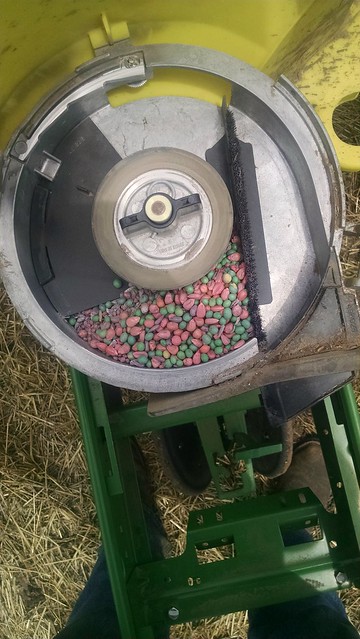
Since I still had sunflower seed in the planter boxes  I added some grain sorghum, corn, soybeans, and some more sunflower seed that was in the left over seed pile in the shop. All of this was seed that had been cleaned out of the planter so the cost of the seed was already paid for by the full season crop. This was planted on wheat stubble that was fallow until grain sorghum is planted next June, the seed was left over, part of the field was fertilized got the fertilizer that was left in the planter, so the only real expense was my time and wear and tear on the planter.

2015-12-21_12-14-50
The seed mix I planted. It's a mix of corn, soybeans, sunflowers, and grain sorghum. This is some seed that had been cleaned out of the planter the last couple of years.

I started with a seed population of 30,000 and decided to bump that to 40,000, for two reasons a, to see what it would do and b, I was getting tired of sitting in the tractor. I picked 30,000 because that is high for sunflowers, low for grain sorghum, high for corn, and extremely low for soybeans. I used the sunflower seed meter disk since they were the closest to medium size and played with the vacuum until I was satisfied with the seeding rate. I wasn't overly concerned with seeding accuracy due to the purpose of this crop.

I seeded this on July, 30th in a normal year nothing should have made it to full maturity. With the mild fall and late killing freeze the sunflowers did, but didn't retain seed and some shorter season corn did might of made it to physiological maturity. Both the sorghum and corn should have been high nutrient level in the plant at the time of a killing frost.

2015-12-20_11-55-01
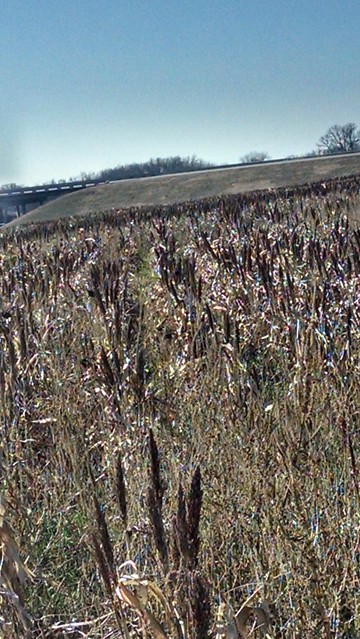
Looking down the row, I ended up with more grain sorghum in the mix that I had originally planned. I didn't put any more bags in, but at about 15,000 seeds per pound when compared to the other seeds it makes sense.

I was surprised at the amount of volunteer wheat growing in it between the rows. Having it growing will extend the time that a root is actively growing. I feel root activity adds considerably to to soil health.

2015-12-20_11-55-41
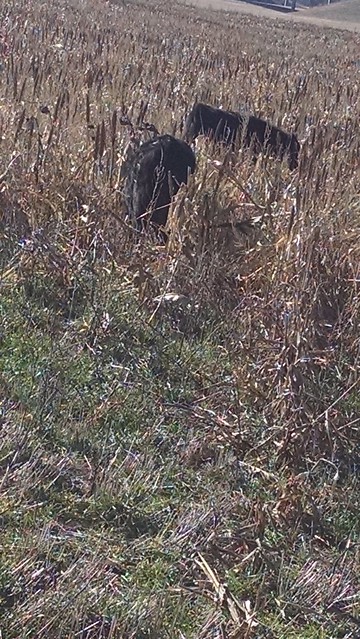
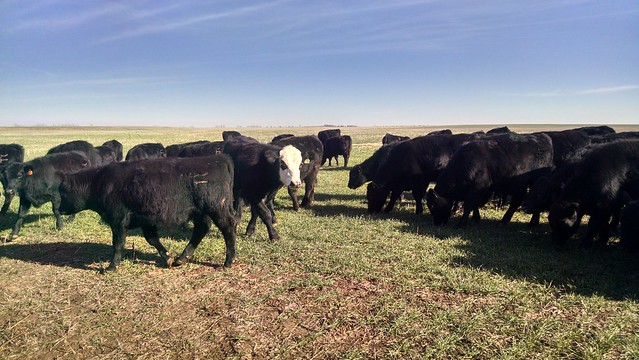
Some calves grazing it. Those are sunflowers to the left of the calf in the foreground.

2015-12-20_11-54-10
To simplify the fencing I including part of the adjoining wheat field. Typically we don't pasture wheat, but it is an accepted practice for the area. The calves will be of before the wheat gets to the jointing stage this spring so there will be no permanent harm to the wheat.

I don't have access to scales to measure growth so I will track the amount of hay I feed compared to what I would have fed in a drylot. Normally we feed medium quality brome, priced at about $45 a bale.

In future years I will add a few turnips or radishes and Austrian winter peas. I think this will be an inexpensive way to add even more diversity. The turnips or radishes will have deep roots along with the sunflowers and will absorb nutrients and the peas will convert atmospheric nitrogen to usable nitrogen in the plant that will go into the soil after it decomposes. The peas might over winter, I haven't found a definitive answer, but even if they do it should be simple to kill out in the spring when I do spring burn down for the volunteer wheat.

Tuesday, March 3, 2015

Where our corn is going

Normally our corn is sold to a cattle feedlot to be used as an ingredient in cattle feed. This year it is going to an ethanol plant. This is the first time that we have delivered to an ethanol plant, some of the corn and grain sorghum that we have delivered to elevators might have gone to ethanol.

Loading corn bound for an ethanol plant.
I posted this picture to twitter, @ksfarmboy, today while loading our semi for the drive to Russell, Kansas.

Our grain prices have changed greatly in our area the past year. Typically in my area corn is priced twenty cents a bushel, 56 pounds per bushel of both corn and grain sorghum, more than sorghum. China started importing sorghum last year and has been aggressively importing it this year. This has driven the sorghum price locally to a over a dollar a bushel over corn, making corn a natural alternative for sorghum in many Kansas ethanol plants and for other end users of sorghum in the area.
The corn is being delivered to White Energy in Russell Kansas. This ethanol plant is combined with a wheat gluten plant and share many resources. To learn more about it the plant.


Thursday, November 21, 2013

Harvest update 13

We wrapped up soybean harvest and wheat seeding the end of October and moved on to corn and then grain sorghum harvest.

There were some mechanical setbacks with harvest, a nagging problems with a header during soybean harvest, the header is the front part that cuts the plant and brings them into the combine. I was seeding wheat, but they told me they usually had it repaired by the time of day that the soybeans were ready for harvest, most crops will take on moisture from dew or frost overnnight and will not harvest properly until late morning.

The combine we use for corn had a couple of major components fail that took quite a bit of time to repair. After that corn harvest was smooth sailing.

I tried harvesting grain sorghum while the rest of the crew harvested corn, but was only able to do a about a hundred acres due to high moisture content of the grain and having to utilize a couple of grain bins that have huge fans that can dry the grain to acceptable levels for storage.

I shifted my attention to helping with corn harvest since we were storing the rest of the crop on the farm for winter and spring delivery to cattle feedlots and feed mills. Our irrigated corn is very high quality that cattle feeders and feed mills recognize and will possibly pay premium. Also my area uses more corn than is raised locally.

The last field of corn harvested was one that was planted to drought tolerant hybrids on a field that has a slightly limited irrigation water available and considerable variation in soils, this can make getting enough water in the soil for the crop challenging particularly in hot dry and weather periods. Half of the field was planted to seed from Pioneer/DuPont gene marker assisted breeding and the other half utilized Monsanto's drought tolerant bio tech trait. The whole field averaged 170 bushel an acre which is very good for it. I was very pleased considering the non irrigated portion was planted with the same seeding and fertilizer rate as the irrigated part, ideally the non irrigation portion would be planted with 6,000 less seeds an acre and save a 1/4 or more on fertilizer.

irrigated corn in a pasture?
This is the field that was planted to the drought tolerant corn, it's along a creek with native pastures on all 4 sides. In the foreground is some of the native plants that are common on our virgin prairie.


Dryland corn
This is some of the dryland corn on that field, this happens to be from the Pioneer seed. The ears were smaller than the DeKalb corn, but very uniform and every plant had an ear except for what the deer ate.

Untitled
This is an ear of corn from the DeKalb seed on the dryland. It had kernels set on 20 rows, I've only seen a few ears of corn that was 20 row in my entire lif

After we finished corn that afternoon I cut a test sample of grain sorghum. I had heard from neighbors and elevator employees that they hadn't been any below 17% moisture. I was surprised the sample was 15.6% moisture, so I went back and cut a semi load, that load was 15.3% moisture and has been the highest moisture since then. Grain sorghum over 15% is discounted and higher moisture levels get discounted at higher rates. The yield has been very goood and test weights higher than I expected considering the cool spell during August, the truck drivers have reported test weights up to 62 pounds a bushel, the standard is 56 pounds a bushel. Plants have gone down in places in fields, this is another problem we face with growing it. I tried a new sorghum from Pioneer/DuPont and was very pleased with it, generally there isn't new sorghum seed released so getting a new hybrid to plant is exciting.

I feel we are moving into a more normal weather pattern and with my limited experience with drought tolerant corn it will be a viable option than grain sorghum and will allow me to better maximize my labor. Many times dryland corn is ready for harvest during a slow time in September between irrigation and the beginning of wheat seeding and soybean harvest when we have more hours of daylight. I've gotten lucky this year with sorghum drying down in the field as it has, normally it won't we have to take the discounts. Freeing up time and labor now would allow time to expand our cattle enterprise and to be more timely with the management. 

On of my seed dealers that also farms has experimented with planting corn lato, I assume mid June. He left a portion of a sorghum field and then planted corn. I think this is the second or third year of experimenting with this and was very successful this year. He mentioned that he might try late planting corn on one of his better dryland fields. The reason for the experiment was to try to time the corn's water needs to the typical rain pattern of August, these are the rains that help our sorghum produce the yields it does.

Saturday, February 25, 2012

Why we choose GMO crops

There were many reasons that we choose corn and soybean varieties that contain GMO traits. Many things took place near the time when GMO crops were released. We increased the acres of our land that we used a no till cropping system that relies on crop rotation as much as herbicides to control weeds. The government farm program was greatly changed that allowed us to plant a variety of farm program crops that we needed in our rotation. In the previous program farmers were only allowed to plant crops according to "base acres", historical crop planting, without a lot of paperwork and taking some acres out of the program or buying or renting land that contained the necessary base acres. In my part of Kansas most land contain largely wheat acres, due to wheat followed by wheat for many years as the primary crop rotation. Wheat is great for a rotation, particularly when rotating to corn or grain sorghum in an area like this where water availability can be a challenge, but a poor choice for continuous cropping particularly when combined with a moldboard plow that places all of the residue in what is essentially a dry tomb that only allows for minimal decomposition or burning the residue off and allows for increased soil erosion and poor soil health.

Before the advent of Roundup Ready Soybeans, Roundup is a non selective contact herbicide, the herbicide choices for weed outbreaks were limited. a product that was effective for us in past was Cobra, but it made the soybeans look very sick. We were some of the early adapters of no till in our area so a lot of trial and error in crop rotations took place and herbicide carryover and rotation restrictions are always a concern. After experimenting soybeans were found to be a good fit between grain sorghum and wheat. Rotation restrictions also puts some limits on the preplant residual herbicide choices and sometimes also on the herbicides we can apply over the top during the growing season. This makes RoundUp, active ingredient glyphosate, very attractive since there is no rotation restrictions following application of it. Using Cobra as an example, it has a 12 months rotation restriction to wheat, we typically seed wheat within less than a week following soybean harvest so if we used it we would have to either idle the land for a year or plant another crop the following spring.

We plant corn that contain both herbicide tolerant and insect resistant corn on irrigated fields. Initially we were reluctant of planting both Roundup Ready soybeans and corn in the rotation, because of the chance of developing herbicide resistance in weeds. Insect resistant corn was very appealing because it controled corn borers without the need for organophosphate insecticides, these were a very effective class of insecticides that killed every insect present in the applied area and has been banned a few years ago. With GMO corn we have targeted insect control and according to USDA-ARS researcher Dr. Jonathan Lundgren's has found a tremendous amount of predator insects present in fields of Bt corn. Dr. Lundgren feels that farmers might want to consider saving seed expenses by reducing the amount of Bt corn they plant because of the effectiveness and widespread use. The last few years we've planted corn with stacked traits to obtain the insect resistance we feel we need in the corn varieties that best suit our irrigated fields. With so many different traits available care is taken to note which fields are planted to herbicide resistant corn if follow up weed treatment is needed, all of the necessary refuge for the insect resistant traits are planted first. We plant seed from all three major GMO technology companies, each Bt corn is slightly different, we try to match the seed variety that's best suited to the field.

Our non irrigated corn, in the years we feel that our higher quality land has adequate moisture to raise a corn crop, we plant heebicide resistant corn. Insect resistant traits aren't necessary because of time between possible corn crops, diverse rotation and the physical distance to other corn fields and it reduces seed expense on a crop that might fail. sometimes seed dealers will give us a bag or two of seed that they think is ideal for those fields that contain insect resistant traits.

For the last few years in our soybeans were seeded them in 15 inch rows. This narrower row spacing allow the plants close the rows earlier and shade out late germinating weeds. I'm wanting to try this on corn also, the combine attachment for corn has to match row spacing so this is an added expense for a specialized piece of equipment. This past year in a weedy corn field I noticed the narrow strip where the fertilizer is applied next to the corn row was largely void of weeds. I think with narrower rows combined with how we apply fertilizer might decrease weed pressure and the possibility of a late herbicide application.

Sorghum and sunflowers are such a minor crop and small market, seed companies didn't see enough market for the time and research to develop GMO traits for them. After the export challenges faced by corn and soybeans GMO wheat research was essentially shelved, there are rumors that research will resume in the near future. These crops in addition to soybeans are what we grow on our non irrigated land, most of our acreage isn't irrigated.

Sunday, August 28, 2011

August update from down on the farm

In my area, north of I70 in central Kansas many of the crops look good, the corn will be disappointing due the heat and drought conditions in July. Sorghum and soybeans look good thanks to timely rains in early August. My understanding that the area south of I70 is still in drought conditions.

Heat stress corn
Two ears of corn from the same field. The ear on the left is very nice but you can see where that heat affected the pollination. The ear on the right was on the edge of getting irrigation water, so it had water in addition to heat stress. There are ears like both of these scattered through the field, but more like the one on the left than the one on the right.


grain sorghum b '11

grain sorghum a '11
A couple of picture of our grain sorghum. It's headed out very nice and thanks to timely rains the past few weeks it has tremendous potential. Being a crop that originated from Africa it handles the heat well. In fact it thrives on the heat that is common in July and August. From my experience in dry years we will receive August rains, in addition to soil water savings from seeding directly into last year's wheat stubble that is timely for sorghum production.

I haven't taken a picture of our soybeans but they have the potential for having a nice crop also.

Monday, July 25, 2011

Heat wave

We are in the grips of the heat wave that is sweeping most of the nation. It's hard on everything outside. Our corn is in the high water use growth stage, it's using .40 inches of water use a day. It can be a challenge keeping irrigation running. Engines that run the pumps and generators can overheat and shut off, we have gauges that will shut off the engines before they're damaged. Our low humidity is increasing the evaporation even with drop nozzles that put water into the corn's canopy.

drought corn
This is a corn field that has either been put up as hay or chopped for silage. The brown strips are corn that has been left for insurance adjustors to verify loss. Normally the corn would still be green rather than brown. This field is only 80 miles from where we farm.

The corn yields are being hampered by the high temperatures even with adequate water. During pollination the pollen is damaged from the high heat and reduces the kernels that will be on each ear of corn. With temperatures in the low 90's at midnight it's hard for corn to release the water it used earlier in the day to transport nutrients from the soil, this also hampers yields.

Our irrigated soybeans need .30 inches of water a day, but they are getting sacrificed some right now to keep the water on the corn. They are a very resilient crop and if we can get some rain soon they will be fine, the more critical time for them to have water will be in a few weeks when they start setting and filling pods. So there is still time to water them to make a respectable yield.

On a drought tour of extreme southwest Kansas Governor Brownback he was quoted in the news saying. “There’s been less rainfall this year than in the peak of the 1930s Dust Bowl with the same heat and wind. Hats off to the producers for being such good stewards.” This shows just how extreme the drought is in the south western portion of the state. It is also a testament to farming practices that have been implementing since then, we no longer bury the stubble leaving bare soil vulnerable to wind.

Sunday, July 24, 2011

Report from the farm

Things have been mighty hectic down on the farm since the last time I took time to write. All the spring seeded crops are in, wheat harvest went pretty smooth, and I was able to plant 300 acres of sunflowers in wheat stubble. We did have a hail storm move through at the beginning of wheat harvest, it stripped the leaves off of the corn and knocked wheat out of the heads. Our non irrigated corn which is planted earlier still shows signs of stripped leaves, but the irrigated corn that was still going through a growth spurt and has nice healthy leaves.

Hailed corn
This was taken the day after the hail storm. This field had the least damage done to it, but it was still sickening to look at it that morning.

Our wheat yields were average to slightly better. Quality was high, both test weight and protein content was high this year. The standardized weight for wheat is 60 pounds a bushel for number 1 wheat, nearly every load of our wheat had a test weight of 6o or better with many loads 61.5 or better. The protein content of our wheat ranged from 10.5% to 12% with most of it in the 11% range. This is a very good protein content for our region, in the lower rainfall areas of western Kansas.

pre wheat harvest 11
I took this right before wheat harvest. The darker stripes are a different variety of wheat. I had just a little bit left in the seeder and it mixed with the other seed.

wheat harvest 11e
This is the same field at harvest, facing a different direction in this photo. Dad is cutting the terraces, terraces are ridges put made in fields to redirect water to reduce soil erosion. The headers, the part on the front that cuts off the crop, doesn't flex so we have to harvest with the terraces.

I've added various pictures and descriptions to my Flickr account. My photos that I use from my blog are there along with many that I haven't used. The photos range from basic information to more technical issues.

Wednesday, May 25, 2011

Spring '11 update

We've been through some extreme weather the past month. There were records set for high temperatures and then records were set for low high temperatures a few days later. When we started planting corn in early April we had idea soil moisture, but after a few hot and windy days the top soil dried out for proper seed germination on our irrigated land and required an irrigation application, except for one field that had raised wheat and then had a sunflower crop on it last year. Wheat stubble served as a blanket to protect the soil from the wind and hot temperatures that helped dry out the other fields. The dry conditions extended into soybean planting up to last week, knowing there was a strong chance of rain for multiple days in the forecast and field conditions were favorable I planted late into the night on both Monday and Tuesday night. From Wednesday through Friday we had up to 4 inches of rain. On this past Monday I was able to resume planting soybeans and Tuesday I had enough time to load the planter with seed before it rained again. We have about 300 acres of soybeans left to seed, which should take about 3.5 days including moving the tractor and planter half way across the county.

One of the rainy day projects was selecting a bull for the cow herd. My youngest son and I traveled to Wolf Creek Angus Ranch to look over their selection of bulls. We got there just as a storm was starting to bear down so we sat in their office looking over the performance data on thier remaining bulls and visited. After the storm ended we walked through the bulls and made the selection. Shortly after leaving the ranch I noticed water running off of fields and filling ditches, I was surprised because they only had 1/4 inch of rain at the ranch. About half way home we drove into a driving rain where we could barely see the road so we pulled into a tractor dealership at a little town, little man only gets excited over John Deere equipment and this wasn't a Deere dealership.

These rains and cooler temperatures will help our wheat fill. Our later seeded wheat will benefit the most, which appears to be a week or so later in maturity even though it may have been seeded several weeks later.

Today I discovered these videos from King Arthur Flour. We are grower owners of a cooperative flour mill that sells hard white wheat flour to King Arthur Flour. We're proud to work with a group of people such as King Arthur Flour that are as passionate about the flour they sell as we are about the wheat we raise.


Friday, April 8, 2011

Update from Flyover Country

Things are starting to get busy down on the farm. We're about to kick off spring planting that rolls right up to the start of wheat harvest followed by what seems like an intense irrigation season, I really appreciate rain then. After a month or so of doing other things the cycle will repeat with fall harvest and wheat seeding that will generally doesn't end until Thanksgiving.

I'm also involved with Progressive Farmer/DTN's View from the Cab column this growing season which should be interesting. Thursday I had a photographer follow me around for part of the day. It was a drizzly slow day at the farm so there wasn't much farming taking place, he plans to return in a couple of weeks and we should be planting irrigated corn then and running pretty hard.

All of our wheat has been fertilized and the fields that needed a herbicide to control weeds have been treated. In the past few weeks our wheat has had a tremendous growth and looks good. The wheat still has a long ways to go, so I won't get to optimistic yet and weather dictates if we have an average or great crop this year.

We've started spraying fields that will go to spring planted crops: corn, soybeans, sunflowers and grain sorghum. We intend to start planting corn on fields without irrigation next week. We plant these fields first and use shorter maturity varieties trying to time the plant's water needs to our normal weather patterns. We've had non irrigated corn yield as low as 20 and as high as 140 bushels an acre. We plant and fertilize for a 100 bushel an acre yield so 140 is maximizing all the inputs, seed and plant nutrients.

This year we will be planting with a tractor equipped with gps guided auto steer. I used it last fall for seeding wheat and was very impressed with how it works , but with spring planting maintaining distance between rows of plants is far more critical for optimum plant growth and development and ease of harvest than it is for wheat.

This past week we reentered the cattle industry with the purchase of 26 heifer cow calf pairs. A heifer is a female bovine that hasn't had a calf, but in this case we use the term heifer to represent her age and the fact she needs some special attention in terms of nutrition. They aren't what I consider fancy cows, but I consider them slightly above average. These girls are very calm and walked away from me then stopped and looked at me when I walked through them the other night. Temperment was a strong selling point for us, a cow that takes her calf and runs to the other end of the pasture will be dangerous to both us and other cattle when they need to be handled and their calves usually have a slower gains weight gains and under utilize natural resources. We intend to own the calves until they reach slaughter weight. I

It'll be great to share with everyone how the cattle business works and all the options cattlemen have available and why we make the choices that we do. The livestock sector is a real passion of mine, but we had to step away to refocus on our cropping system and determine how to incorporate cattle on the farm without sacrificing either them or crops.

Friday, September 3, 2010

Corn harvest

Life down on the farm has been slow, but very shortly things will be busy with fall harvest and wheat seeding.

Corn Combine
This old girl is the combine that we harvest corn with.

We have started harvesting our non irrigated corn this past week. Most of the corn goes to our local "neighborhood" cattle feedlot. We sell some of our corn there directly from the field and they are very competitive on the price they pay for corn. They use corn everyday as a part of the feed ration to cattle, so they can take some corn that is too high in moisture for long term storage. When the moisture inside the kernel of corn is above 15% it will deteriorate over long storage periods and warm temperatures speed up the process.

Corn field
Here is a partially harvested field of corn. We are cutting non irrigated portion of the field, foreground. The irrigated portion in the background will be harvested at a later date.

Our irrigated corn is longer maturity, planted a few days later, and had water when the planted needed it the most so it matures slower. Corn has an amazing ability to maintain grain quality and not fall down while standing in the field so it might not be harvested until November after soybean harvest and wheat seeding. Much of our irrigated corn will be stored on the farm and sold later to either the "neighborhood" feedlot, one of the feedlots within 100 miles of the farm, or an elevator that might blend higher quality with lower quality corn and will most likely sell it to a feedlot or ethanol plant. The demand for corn in my part of Kansas is higher than the supply which allows us to take advantage of good prices.

Monday, February 8, 2010

which corn to plant

As time goes on different opportunities become available for farmers to take advantages of different markets. One that is becoming more attractive to many farmers is conventional corn. During a conversation with a seed salesman last week the subject came up and he mentioned that in north east Kansas conventional, non GMO, corn had quite a bit of interest and that his seed supplies were becoming tight. He showed me variety tests and pointed out a conventional variety that had performed well in the tests.

When considering going to a specialty crop such as this, several things have to be taken into consideration. Am I going to have to add different equipment to seed or harvest? What am I going to do with it after I harvest it, store it on the farm? How far will I have to ship it to get a premium? I will no longer have insect resistance in my plant so I might have to add insecticide at planting time for root worms, and then I might have to apply insecticides again for insects when the corn is bigger. How close can I plant to GMO corn?

The equipment is the same for planting. A detailed cleaning is required to ensure seeds don't find their way into the field since this is is a field size trial. Planters are easy to clean out, a few minutes a row and that is accomplished. The combine on the other hand, can be more time consuming to clean. If I plan to have that field ready for harvest first then I can ensure the combine being free of GMO seeds because of wheat harvest.

Being a specialty crop I won't be able to market it for a premium locally, particularly in my low corn production area. I will have to store it on the farm and ship it at a later date. The good thing is we have more than adequate storage space and equipment to handle it and keep it in condition.

It will most likely have to be shipped to Kansas City or farther, so the premium has to be enough to make it worthwhile. My local corn price is strong and the trucking can eat up much of the premium. I can still sell the corn locally to the feedlot, it's still yellow corn except it doesn't contain genes that protect it from herbicides or insects, without a premium.

Plant protection is the next challenge since the plant is no longer herbicide tolerant and insect resistant. We haven't been using Round Up in our corn, even though it is tolerant of it, because we wanted to reduce our chances of resistant weeds. Our normal weed control protocol shouldn't be a problem. Insect control could be a problem, working with a Certified Crop Adviser is a benefit in this area. He will help scout fields for troubling insects and recommend the best product to use.

Non GMO corn will need a buffer from GMO corn. I know that corn pollen from yellow corn can blow across a road and contaminate white corn. In the article Banking on non-biotech "You need to grow non-GM corn at least 660 ft. from a GM variety, said G.W. Dimmett Premium Ag Products general manager." I can easily accomplish this from the lack of corn production in my area and fields that are isolated.

I think it is possible to raise conventional corn, especially with supplemental irrigation. I want to see varieties in some more yield tests and how the heat stress from a normal year effects them.

Monday, November 16, 2009

Day on the farm during corn harvest

Here is a typical day for me during corn harvest. After dropping my son off at school. I go to the farm shop and pick up supplies and any parts that I might need. Generally I make sure that I have engine oil, hydraulic fluid, and grease for the combine.

corn,corn harvest,farm

An ear of corn on the plant with it's husk pulled back. This is what it looks like when it is ready to harvest.


corn,corn harvest,farm
This is what it looks like as the combine's header moves through the corn. It pulls the plants down crushing the stalk while it strips the ears off.


When I get to the field I start fueling the combine. While it is fueling I check the fluid levels, grease the combine and check for anything that might to be out of place. The combine will normally take 50 gallons of diesel fuel or more, but that is enough for me to operate for 2 days. Combines have many moving parts that require grease to keep them operating smoothly and to prevent premature wear. I inspect much of the combine while I am greasing it. After fueling and greasing I wash the windows. A great deal of dust is produced while harvesting and it sticks to the windows, the dust makes it hard to see particularly at night.


corn,corn harvest,farm,harvest
A load of corn on a semi. Something wasn't set right and we were getting part of the cob with the grain.

Corn is unique to other crops that we harvest in that the combine's header pulls the ears off and takes very little else of the plant. This allows us to begin harvesting earlier in the morning and stop later in the evening. With the other crops the plant is cut off and many times the dew from the previous night needs to dry off so that the grain will separate easier.


corn,corn harvest,farm,harvest


corn,corn harvest,farm,harvest
These are a couple of pictures of our on farm grain storage and a truck unloading corn.

Then I begin harvesting corn. The combine's header will take 6 rows of corn at a time. I move through the field harvesting at about 3 miles an hour. When I get to the other end I unload and harvest back the the other end. I watch to stay lined up on the rows and monitor the grain coming into the grain tank. If I start getting too much of the plant or cob I will have to stop and adjust the combine. Many times I will spend 10 hours or more harvesting corn, sometimes longer if I have empty trucks to unload in.

We store most of the corn on the farm in grain bins and will sell it during the winter and spring. The part of Kansas that I live in is unique in the fact that we use more corn, mostly for cattle feed, than is raised. This allows for a strong market for corn throughout the year. Most of our corn will be sold and fed within 100 miles of where we raise it. There is an ethanol plant that is close, but they use grain sorghum.