Showing posts with label cover crops. Show all posts

Friday, October 12, 2018

First year cover crop experience

Way back in September 2017 we tried some cover crops on fields that were scheduled to be planted to either corn or grain sorghum. On some fields we planted a blend of rye, triticale, winter barley, turnips, radishes and a rapeseed with intentions of grazing cattle on it in the fall. We also had some fields with rye. Normally grain sorghum is planted in early June in fields that had wheat harvested off of them the end of the previous June. We try to rotate sunflowers through between wheat and corn/grain sorghum every 8 years so.

This field was the grazing blend that wasn’t grazed due to dry weather the prevented proper fall growth. I had switched from a yellow variety to a red sorghum variety. The weed control has been very good here. The rain and weather aligned with sorghum needs very well and it’s tough crop that is still suited for poor hill ground compared to corn.


We had the same grazing blend here that was grazed. It was only grazed for about 3 weeks because it was dry and didn’t grow as expected. I also planted the covers about a notch shallower than I normally plant wheat I didn’t want to bury the radishes and turnips. I think I would have been better at the deeper seed depth. We have a little more weed pressure, not bad and the favorable weather we can grow good sorghum and weeds.


For comparison this sorghum was planted into wheat stubble that had double crop sunflowers last year, the sunflowers had done very good last year. We like the sunflowers as a double crop for many reasons. We can plant them as late as July 20th and make a crop, they are harvested high off the ground so our wheat stubble remains in tact on the field. Finally the tap root goes deep in the soil and extracts nutrients other crops can’t reach, the deep roots serve as a pathway for following crops to root deeper. It seems crops following for the next 3 or 4 years just do a little better. We have an irrigated field that has had a corn, soybean, wheat and double crop sunflower rotation for years. I’d love to have a soil pit on it some time, I imagine there is black streaks several feet deep  every few inches.

The corn is already harvested where we we have had cover crops. Very good weed suppression and it still has a nice mat of residue on the ground from both the wheat stubble and rye. The corn yields weren’t great due to hot dry weather at pollination. One field has been seeded back to wheat. The other field some of the corn was chopped for silage in early august and the rest was harvested for grain mid September. It has been seeded back to rye and planning to put soybeans on it next spring.

The cereals were sprayed out when they reached the boot stage so we shouldn’t have a problem with making seed and future plants becoming weeds. The plants were at max growth in regards to size and weren’t using nutrients and soil water to make seed yet.

We were a little leary of planting sorghum on the covers because there are little effective herbicide options for weed control after the crop starts growing and unsure of how well our normal pre plant residual herbicides would be with all the residue. We decided to use the pre plant due to thin places in the cover crops to prevent an explosion of weeds there. Corn is a better option because of better herbicide options even for non GMO varieties.

Here is a field planted to rye. It might get grazed later this fall if things work out for us to we used a basic stater fertilizer to help maintain the phosphorus level in the soil. There is another field, the dry land portion of the irrigatated corn, soybean, wheat, double crop sunflower field that has some rye on part of it. It will be interesting to see how and if soybeans respond to the rye cover crop. 

In the future I might experiment with winter legumes such as winter peas and chickling vertch on fields destined for corn or grain sorghum, I don’t think we will have the ground cover we have with cereal crops hindering soil water holding. A mix of them with cereal and turnips might work well. Another consideration is neighboring wheat fields, volunteer wheat can harbor mosaic and cause problems. If we know there is a will be a wheat field next to it, even across the road we plant later after controlling the volunteer wheat. Later planting limits the cover crop choices.


Wednesday, December 20, 2017

Erosion control

Many of our fields are on hills and have terraces to help prevent soil erosion from water runoff. The terraces are ridges that have been built in the field that to slow and redirect the water. The water moves to grass covered drainage ditches. It’s hard for me to explain but this past fall we had a very heavy rain event and I had the opportunity to take a group of pictures of terraces and waterways in use. This field had two years of wheat and is in currently in a rye cover crop so it was near maximum soil erosion protection. This part of this field might be rotated to corn for silage next year or soybeans due to more choices to control weeds after the crop starts growing.


Tuesday, December 22, 2015

Grazing cover crops

There has been quite a bit of discussion about cover crops and dual purpose cover/forage crops for the past few years. Some of the seed blends can get quite costly, I've seen quotes as high as $60 an acre for some seed mixes, this was the price of seed wheat during the height of the high grain price cycle.

Since I still had sunflower seed in the planter boxes  I added some grain sorghum, corn, soybeans, and some more sunflower seed that was in the left over seed pile in the shop. All of this was seed that had been cleaned out of the planter so the cost of the seed was already paid for by the full season crop. This was planted on wheat stubble that was fallow until grain sorghum is planted next June, the seed was left over, part of the field was fertilized got the fertilizer that was left in the planter, so the only real expense was my time and wear and tear on the planter.

2015-12-21_12-14-50
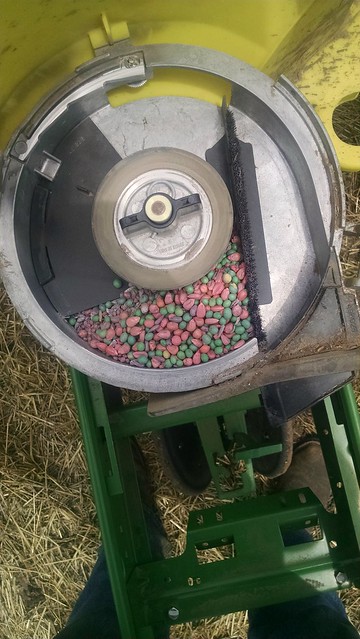
The seed mix I planted. It's a mix of corn, soybeans, sunflowers, and grain sorghum. This is some seed that had been cleaned out of the planter the last couple of years.

I started with a seed population of 30,000 and decided to bump that to 40,000, for two reasons a, to see what it would do and b, I was getting tired of sitting in the tractor. I picked 30,000 because that is high for sunflowers, low for grain sorghum, high for corn, and extremely low for soybeans. I used the sunflower seed meter disk since they were the closest to medium size and played with the vacuum until I was satisfied with the seeding rate. I wasn't overly concerned with seeding accuracy due to the purpose of this crop.

I seeded this on July, 30th in a normal year nothing should have made it to full maturity. With the mild fall and late killing freeze the sunflowers did, but didn't retain seed and some shorter season corn did might of made it to physiological maturity. Both the sorghum and corn should have been high nutrient level in the plant at the time of a killing frost.

2015-12-20_11-55-01
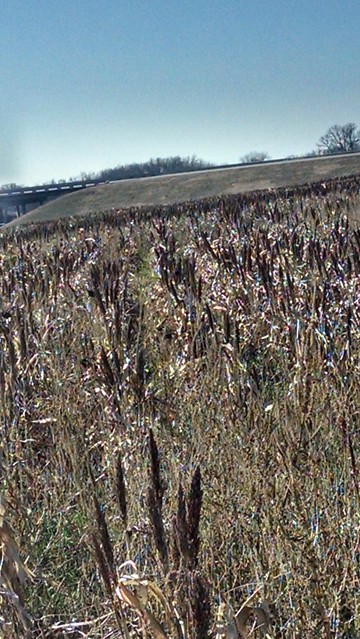
Looking down the row, I ended up with more grain sorghum in the mix that I had originally planned. I didn't put any more bags in, but at about 15,000 seeds per pound when compared to the other seeds it makes sense.

I was surprised at the amount of volunteer wheat growing in it between the rows. Having it growing will extend the time that a root is actively growing. I feel root activity adds considerably to to soil health.

2015-12-20_11-55-41
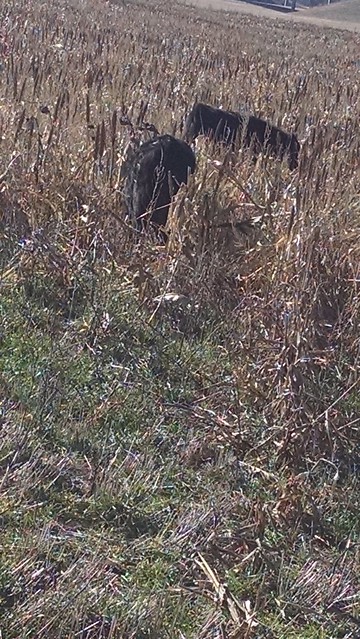
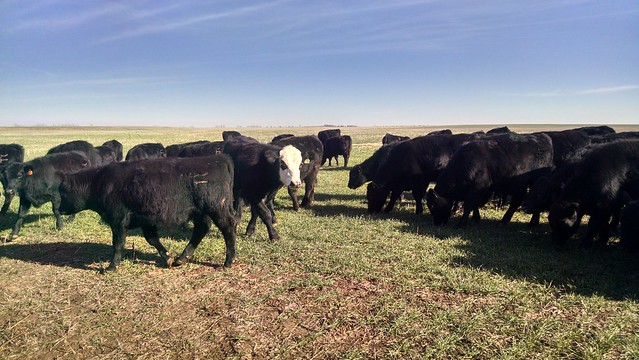
Some calves grazing it. Those are sunflowers to the left of the calf in the foreground.

2015-12-20_11-54-10
To simplify the fencing I including part of the adjoining wheat field. Typically we don't pasture wheat, but it is an accepted practice for the area. The calves will be of before the wheat gets to the jointing stage this spring so there will be no permanent harm to the wheat.

I don't have access to scales to measure growth so I will track the amount of hay I feed compared to what I would have fed in a drylot. Normally we feed medium quality brome, priced at about $45 a bale.

In future years I will add a few turnips or radishes and Austrian winter peas. I think this will be an inexpensive way to add even more diversity. The turnips or radishes will have deep roots along with the sunflowers and will absorb nutrients and the peas will convert atmospheric nitrogen to usable nitrogen in the plant that will go into the soil after it decomposes. The peas might over winter, I haven't found a definitive answer, but even if they do it should be simple to kill out in the spring when I do spring burn down for the volunteer wheat.

Thursday, February 2, 2012

To Cover Crop or not

Authors note: Much of this is my recap of the 2012 No Till on the Plains Winter Conference. I went into the conference wanting to wrap my mind around utilizing cover crops in no till better. I still have many questions, but they might be best answered from experimenting.

Implementing cover crops in no till cropping systems has been a concept introduced to me at the No Till on the Plains winter conference a couple of years ago. Cover crops are plants seeded and grown between cash crops. These plants can be legumes that takes nitrogen from the air for the plant to use, brassica's that are deep rooted that help break compacted layers of soil and trap nitrogen, or grasses that hold soil and take up nutrients.

Gabe Brown, North Dakota farmer and rancher, was the first farmer that really got me interested in this crazy idea. He had found that a complex blend of plant species with varying root depths not only survived, but thrived in through North Dakota droughts. In the initial presentation a few years ago he talked about grazing cow/calf pairs for a month on a cover crop blend, I think he estimated the weight gain on the calves generated $100 or more an acre, that really perked my interest. At his presentation this past winter we told of a corn crop planted in a cover crop blend of cereal rye, vetches, oil seed radishes, turnips and a variety of other plants species. His cost of production was $1.10/bu he made one herbicide application to terminate the rye and set back the vetch enough to not compete with the corn and the cover crop blends provided all the nutrients. The expenses for his cover crops were covered by grazing them with cattle. He showed pictures of a corn crop that was planted into some of the heaviest ground cover of I've ever seen, at around tassel stage the trash was very deteriorated, at harvest the space between the rows were bare with the exception of some vetch that looked about a foot tall, and a couple of weeks later the vetch really started growing.

So Gabe Brown had luck with his cover crops during North Dakota droughts, but how would they deal with a Kansas drought? Gail Fuller, east central Kansas and Ryan Speer, south central Kansas, each gave presentations about their use of cover crops in last summer's drought.

Fuller has had cover crops longer in his rotation and felt early in the season his corn had the potential to be some of his best ever. He showed pictures of it green where his neighbor's corn was burned up from the drought, but relief from the drought came too late for it. After harvesting as forage he planted cover crop blends back to it to protect the soil and keep soil ecology working. The cover crops looked like they had good growth in his photos.

Ryan Speer is transitioning cover crops to his crop rotation and has experimented some the past few years. Speer's dryland corn was horrible, I think he said it yielded in the 15 to 20 bushel per acre range this year, but he noticed his yield monitor jumped up to 60 to 70 bushel range in a spot where there had been a plot of sun hemp between wheat crops three years ago. He stated that evaporation in the fairly short fallow period, late June to early October, is more than the water requirements of many of the cover crops. Speer has also been having rye and radishes flown on to irrigated corn fields late in the irrigation season. These are some very sandy field and he's seen an increase in soil organic matter to help increase both the water holding capacity and fertility of these fields.

So how do I tell how much nutrients are these cover crops are either tying up to be released when they decompose or nitrogen they are "making" in the case of legumes? Ray Ward of Ward Lab, recommends farmers either estimate how many tons of hay the cover crop may make and determine protein value of the various plants or send a vegetative sample from one square yard for a cover crop analysis. Many cover crop advocates emphasizing some very diverse mixes so I feel sending a sample would be more helpful.

How do cover crops effect soil biology? Dr. Jill Clapperton soil biologist and president of Rhizoterra Inc explained that poor soil biology produced poor crops in terms of both crop yields and nutrient content. She went on to tell us that most soil organisms are fed by the soil organic matter and when cover crops are used there are more actively growing roots throughout the entire growing season to keep producing soil organic matter. She also stated that the more diverse mix of plants that are growing on top of the soil the more diversity in soil organisms, since a monocropping system is used for cash crops this leaves cover crops to be a major source of plant diversity. Earth worms are one of the biggest and easiest to recognize soil organisms and they absolutely dislike soils that have had mechanical tillage performed. Mechanical tillage disrupts the soil organisms that earth worms live on.

Fuller commented on having part of a field that was poor even though soil tests revealed that fertility was the same as the rest of the field. A mycorrhizea test revealed that it was severely out of balance there. Clapperton mentioned that Ward Lab and a few others are capable of testing for it now. Determining which cover crops helps correct mycorrhizea problems is a challenge.

I sat in a presentation of Dr. Jonathan Lundgren an entomologist with USDA-ARS, stationed at North Central Agriculture Research Laboratory, Brookings, South Dakota. He does extensive research and studying of predator insects. He stressed that reducing soil disturbance and careful scouting and using insecticides only when thresholds are met are a help preserve insect predators. He felt cover crop blends are helpful in recruiting more predators insects to fields to reduce need for insecticides.

I ran into a neighbor, Craig Ballou, he had a stop on a sunflower crop tour last summer at a double crop sunflower field without commercial nitrogen fertilizer. The field had been in a sun hemp cover crop between two wheat crops. It's a common practice of no till farmers in my area to raise two continuous crops of wheat. From past soil tests on double crop sunflowers in this rotation the nitrogen left was the same as what he had applied so he decided to not apply it. With our winter wheat growing season the soil doesn't warm soon enough for the residual nitrogen from a legume to be available for the wheat other than a possible protein boost.
Sunflower Showcase 3
Here are Craig Ballou's double crop sunflowers on August 30th. No nitrogen fertilizer was applied and Craig said they did very good, I could tell he was proud of them when I asked him about them.

I feel transitioning to cover crops is the next step in our no till rotation. I feel it will be a fairly slow transition as we learn what mix of plants and how to seed them in a timely manner. We will need to start on land we own, partially to insure we receive the long term benefits of it and to also prove to landlords that this crazy idea is viable.