
Things are starting to get busy down on the farm. We're about to kick off spring planting that rolls right up to the start of wheat harvest followed by what seems like an intense irrigation season, I really appreciate rain then. After a month or so of doing other things the cycle will repeat with fall harvest and wheat seeding that will generally doesn't end until Thanksgiving.
I'm also involved with Progressive Farmer/DTN's View from the Cab column this growing season which should be interesting. Thursday I had a photographer follow me around for part of the day. It was a drizzly slow day at the farm so there wasn't much farming taking place, he plans to return in a couple of weeks and we should be planting irrigated corn then and running pretty hard.
All of our wheat has been fertilized and the fields that needed a herbicide to control weeds have been treated. In the past few weeks our wheat has had a tremendous growth and looks good. The wheat still has a long ways to go, so I won't get to optimistic yet and weather dictates if we have an average or great crop this year.
We've started spraying fields that will go to spring planted crops: corn, soybeans, sunflowers and grain sorghum. We intend to start planting corn on fields without irrigation next week. We plant these fields first and use shorter maturity varieties trying to time the plant's water needs to our normal weather patterns. We've had non irrigated corn yield as low as 20 and as high as 140 bushels an acre. We plant and fertilize for a 100 bushel an acre yield so 140 is maximizing all the inputs, seed and plant nutrients.
This year we will be planting with a tractor equipped with gps guided auto steer. I used it last fall for seeding wheat and was very impressed with how it works , but with spring planting maintaining distance between rows of plants is far more critical for optimum plant growth and development and ease of harvest than it is for wheat.
This past week we reentered the cattle industry with the purchase of 26 heifer cow calf pairs. A heifer is a female bovine that hasn't had a calf, but in this case we use the term heifer to represent her age and the fact she needs some special attention in terms of nutrition. They aren't what I consider fancy cows, but I consider them slightly above average. These girls are very calm and walked away from me then stopped and looked at me when I walked through them the other night. Temperment was a strong selling point for us, a cow that takes her calf and runs to the other end of the pasture will be dangerous to both us and other cattle when they need to be handled and their calves usually have a slower gains weight gains and under utilize natural resources. We intend to own the calves until they reach slaughter weight. I
It'll be great to share with everyone how the cattle business works and all the options cattlemen have available and why we make the choices that we do. The livestock sector is a real passion of mine, but we had to step away to refocus on our cropping system and determine how to incorporate cattle on the farm without sacrificing either them or crops.
Friday, April 8, 2011

Friday, March 11, 2011
Wheat update
Our wheat started breaking dormancy the last couple of weeks. Things are looking good right now, but it still has a long time to go before we harvest in late June.
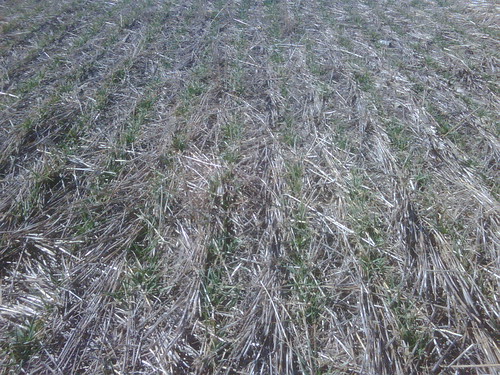
This field is wheat seeded directly into last year's wheat stubble. Second year of wheat is the best yielding wheat in our rotation.
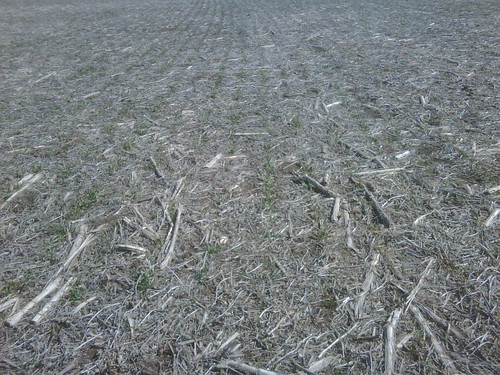
This field was planted in soybean stubble. The bigger pieces of crop residue is from the previous grain sorghum crop. Our stand tends to be a little thin after soybeans, some of it is from the heavy trash, there is some thoughts floating around glyphosate, Roundup's active ingredient, this will need more investigation.
![IMG00124-20110312-1550[1]](http://farm6.static.flickr.com/5017/5521240601_c3c56e2dd8.jpg)
This field was seeded into sunflower stubble. We seem to get real good stands and yields will rival wheat planted into wheat stubble following sunflowers. This field happens to be Hard White Winter Wheat, it's more of a specialty wheat that we only plant a few acres of. The more common wheat for my area is Hard Red Winter Wheat. The only real noticeable difference in growing white wheat is slightly less disease resistance and slightly more head sprout in a very wet summer. I prefer the taste of white wheat, it seems to be a little sweeter taste.
We started fertilizing our wheat. We use a liquid fertilizer solution that is 28% nitrogen. We are trying to fertilize it as late as we can, but before the plant needs it and becomes deficient. By late fertilizing we are attempting to add as much protein to grain as possible, our area isn't known for producing high protein wheat and is mixed with wheat from western Kansas. If we let our wheat become deficient then we lose yield potential because the plant will only make the amount of grain that it can support even if nutrients are provided later when it needs them.
My wife and I drove home from Florida after attending the Commodity Classic going through Texas north of Dallas, the middle of Oklahoma and Kansas the wheat looked pretty decent at highway speed or faster. The western part of Kansas is going to have a poor crop due to not having enough top soil moisture last fall at seeding time. The poorer wheat will be destroyed, some never emerged last fall and I've heard reports that many fields weren't even seeded due to lack of rain.
This field is wheat seeded directly into last year's wheat stubble. Second year of wheat is the best yielding wheat in our rotation.
This field was planted in soybean stubble. The bigger pieces of crop residue is from the previous grain sorghum crop. Our stand tends to be a little thin after soybeans, some of it is from the heavy trash, there is some thoughts floating around glyphosate, Roundup's active ingredient, this will need more investigation.
This field was seeded into sunflower stubble. We seem to get real good stands and yields will rival wheat planted into wheat stubble following sunflowers. This field happens to be Hard White Winter Wheat, it's more of a specialty wheat that we only plant a few acres of. The more common wheat for my area is Hard Red Winter Wheat. The only real noticeable difference in growing white wheat is slightly less disease resistance and slightly more head sprout in a very wet summer. I prefer the taste of white wheat, it seems to be a little sweeter taste.
We started fertilizing our wheat. We use a liquid fertilizer solution that is 28% nitrogen. We are trying to fertilize it as late as we can, but before the plant needs it and becomes deficient. By late fertilizing we are attempting to add as much protein to grain as possible, our area isn't known for producing high protein wheat and is mixed with wheat from western Kansas. If we let our wheat become deficient then we lose yield potential because the plant will only make the amount of grain that it can support even if nutrients are provided later when it needs them.
My wife and I drove home from Florida after attending the Commodity Classic going through Texas north of Dallas, the middle of Oklahoma and Kansas the wheat looked pretty decent at highway speed or faster. The western part of Kansas is going to have a poor crop due to not having enough top soil moisture last fall at seeding time. The poorer wheat will be destroyed, some never emerged last fall and I've heard reports that many fields weren't even seeded due to lack of rain.
Monday, January 31, 2011
Winter meetings
After the first of the year when things are generally slow on the farm, meetings heat up. There are many production meetings ranging from local to national level. I'm fortunate to have a good one in what is practically my back yard.
Last week I attending No-till on the Plains Winter Conference. This was their 15th annual meeting and my 7th, I've been to everyone of them since coming back to the farm, my dad was one of the founding board members. Attendees were primarily from the Great Plains, the region that covers Texas to North Dakota and Missouri River to the Rocky Mountains. Each year brings more international attendees, particularly from the Canadian prairie Providences, in the past a lady connected to a Former Soviet Union State has attended.
Over the years the list of presenters have had an international flair either from experience and cooperating with foreign researchers or are farmers or crop consultants. This year the international guest speakers was a crop consultant from South Africa, a group of Canadian farmers from Saskatchewan and Alberta and Canadian researchers.
The conference kicked off with with Apple computers co founder Steve Wozniak speaking in a relaxed question and answer setting. He focused on innovation and mentioned how smaller companies can be more flexible and can cater to specific markets to fill a niche that larger companies can't meet. I didn't win the Ipad door prize autographed by the Woz.
There were three speakers in the breakout sessions that left an impression on me. Part of the reason they left the impression is not just validation for what we currently do, but also help nudge us in the direction of even more sustainability. As the definition of sustainability changes I have determined I will never claim as being sustainable.
Jill Clapperton, a soil scientist that studies soil biology and health. She had an in depth presentation about how soil residue, soil structure and soil biology are inter related and essential in a healthy no till cropping system. She also teased us with the findings in a soon to be released study by a graduate student working under her on healthy soils producing healthy food, I will be looking for it. Instead of attending her last presentation I went to Paul Jasa, engineer with University of Nebraska Lincoln, he understands no till systems and the equipment upgrades required, great source for sifting through the various attachments.
Francis Yeatman, a South African crop consultant had a very interesting presentation on soil fertility and the need for indepth analysis of soil tests and following up with tissue testings. He had many clients that had over applied fertilizer and lacked the proper balance of available nutrients that resulted in deficiencies. In his work he has found that not all nutrient sources are the same, some can help build soil structure while supplying crops with the nutrients while others only provide the crop with nutrients. In his information packet was a chart showing the effect of high and low nutrients levels have on other nutrients.
Jonathan Lungren, a USDA-ARS researcher at the North Central Agricultural Research Laboratory. Spoke about preserving beneficial insects in a no till system. Much of his work revolved around corn rootworms which seems to have a built in defense mechanism that requires a great number of beneficials to control. Dewayne Beck of Dakota Lakes research farm had contacted him to determine why corn rootworms weren't a problem. They determined after adding rootworms to the rows of corn that enough predators were present to prevent any noticeable loss. A favorable environment was created for beneficials due to a varied crop rotation that included cover crops and limited needs of pesticides.
I feel our farm is moving in the right direction. We soil test on a regular basis and observing plants for nutrient deficiencies is part of our in season scouting program. Our increasing use of sunflowers as a double crop between second year wheat and grain sorghum or corn shows several benefits because of more plant diversity, increase in beneficial insects, we have actively growing plants feeding soil biology during what would be a long period of not having desirable plants growing, and I feel wheat stubble decomposes faster putting carbon into the soil faster. We have an irrigated field that has a wheat and double crop sunflowers prior to a corn crop might be a candidate for some non Bt corn trial based on some of Lungrens comments about sunflowers attracting beneficial insects.
I also visited with some an up start oil processor that was trying to generate interest in Safflower for bio diesel. The timing of seeding and harvest works well for us as a replacement for some acres of soybeans and it also the oil content ranges from 35% to 40% even with lower grain yields it has potential to out produce soybeans in oil content. I feel as an industry we need to keep finding and improving crops to increase oil production on current crop acres.
Last week I attending No-till on the Plains Winter Conference. This was their 15th annual meeting and my 7th, I've been to everyone of them since coming back to the farm, my dad was one of the founding board members. Attendees were primarily from the Great Plains, the region that covers Texas to North Dakota and Missouri River to the Rocky Mountains. Each year brings more international attendees, particularly from the Canadian prairie Providences, in the past a lady connected to a Former Soviet Union State has attended.
Over the years the list of presenters have had an international flair either from experience and cooperating with foreign researchers or are farmers or crop consultants. This year the international guest speakers was a crop consultant from South Africa, a group of Canadian farmers from Saskatchewan and Alberta and Canadian researchers.
The conference kicked off with with Apple computers co founder Steve Wozniak speaking in a relaxed question and answer setting. He focused on innovation and mentioned how smaller companies can be more flexible and can cater to specific markets to fill a niche that larger companies can't meet. I didn't win the Ipad door prize autographed by the Woz.
There were three speakers in the breakout sessions that left an impression on me. Part of the reason they left the impression is not just validation for what we currently do, but also help nudge us in the direction of even more sustainability. As the definition of sustainability changes I have determined I will never claim as being sustainable.
Jill Clapperton, a soil scientist that studies soil biology and health. She had an in depth presentation about how soil residue, soil structure and soil biology are inter related and essential in a healthy no till cropping system. She also teased us with the findings in a soon to be released study by a graduate student working under her on healthy soils producing healthy food, I will be looking for it. Instead of attending her last presentation I went to Paul Jasa, engineer with University of Nebraska Lincoln, he understands no till systems and the equipment upgrades required, great source for sifting through the various attachments.
Francis Yeatman, a South African crop consultant had a very interesting presentation on soil fertility and the need for indepth analysis of soil tests and following up with tissue testings. He had many clients that had over applied fertilizer and lacked the proper balance of available nutrients that resulted in deficiencies. In his work he has found that not all nutrient sources are the same, some can help build soil structure while supplying crops with the nutrients while others only provide the crop with nutrients. In his information packet was a chart showing the effect of high and low nutrients levels have on other nutrients.
Jonathan Lungren, a USDA-ARS researcher at the North Central Agricultural Research Laboratory. Spoke about preserving beneficial insects in a no till system. Much of his work revolved around corn rootworms which seems to have a built in defense mechanism that requires a great number of beneficials to control. Dewayne Beck of Dakota Lakes research farm had contacted him to determine why corn rootworms weren't a problem. They determined after adding rootworms to the rows of corn that enough predators were present to prevent any noticeable loss. A favorable environment was created for beneficials due to a varied crop rotation that included cover crops and limited needs of pesticides.
I feel our farm is moving in the right direction. We soil test on a regular basis and observing plants for nutrient deficiencies is part of our in season scouting program. Our increasing use of sunflowers as a double crop between second year wheat and grain sorghum or corn shows several benefits because of more plant diversity, increase in beneficial insects, we have actively growing plants feeding soil biology during what would be a long period of not having desirable plants growing, and I feel wheat stubble decomposes faster putting carbon into the soil faster. We have an irrigated field that has a wheat and double crop sunflowers prior to a corn crop might be a candidate for some non Bt corn trial based on some of Lungrens comments about sunflowers attracting beneficial insects.
I also visited with some an up start oil processor that was trying to generate interest in Safflower for bio diesel. The timing of seeding and harvest works well for us as a replacement for some acres of soybeans and it also the oil content ranges from 35% to 40% even with lower grain yields it has potential to out produce soybeans in oil content. I feel as an industry we need to keep finding and improving crops to increase oil production on current crop acres.
Saturday, December 11, 2010
Rural Decline
This morning I learned a high school classmate's dad passed away. Leo ranched and farmed and commonly combined resources with his brothers to build operations that would support their families. I went to school with his sons Darren, a classmate, and Dustin, a year ahead of me in school, both ranch in the area. These are some of the very few that I went to high school went that chose a career in production agriculture.
Thinking about them today, a problem that will soon effect rural America in the next few years became clearer. Many farmers and ranchers are approaching retirement age and many do not have another generation to take over.
For many decades we've told rural kids that there wasn't a future for them in rural America and they needed to go to college and move to the city. In fact we give college scholarships to the brightest to ship them out even faster. The kids took the rural work ethic with them and many have been successful. As a result our rural towns and communities are declining in both population and leadership.
Reversing the decline and increase opportunities in rural America will take input from many people with diverse areas of expertise. Rural development plans can not be a one size fits all and will need to be tailored to each location.
Thinking about them today, a problem that will soon effect rural America in the next few years became clearer. Many farmers and ranchers are approaching retirement age and many do not have another generation to take over.
For many decades we've told rural kids that there wasn't a future for them in rural America and they needed to go to college and move to the city. In fact we give college scholarships to the brightest to ship them out even faster. The kids took the rural work ethic with them and many have been successful. As a result our rural towns and communities are declining in both population and leadership.
Reversing the decline and increase opportunities in rural America will take input from many people with diverse areas of expertise. Rural development plans can not be a one size fits all and will need to be tailored to each location.
Sunday, September 26, 2010
New Markets??
As I look forward to the long hours and near madness of seeding wheat starting this week, I also think about how to market it. With much debate and interest in local/regional food the question I find myself asking is, "How can I take advantage of marketing it to bakeries and restaurants in Kansas City and Wichita as flour?"
Normally we sell all of it, except for a small portion that's kept for seed, as a commodity to either our local grain elevator, which in turns markets it to a multinational grain company, or we haul it directly to the multinational ourselves. Multinational companies offer many advantages such as a variety of forward contracts that allow us to capture potentially favorable prices and peace of mind of getting paid timely .
On the other hand a small flour mill offers the opportunity to market the grain as a finished product to bakeries, restaurants, and the public that want closer contact to the farmers that produced it. A small flour mill is another opportunity to add a few needed jobs in rural America, it won't provide enough jobs to stop the out migration though. The potential downside is a small mill could be slow paying and lack the economies of scale for longevity even when charging a premium price.
Shepard's Grain is an excellent example of a group of farmers in the Pacific Northwest working with an ADM flour mill to develop flour products to their specifications and then marketing the flour to bakeries, delis and other commercial wheat flour users. Using a cost plus pricing system creates a very transparent pricing scheme and rely on farmer owners to help with promotion allowing end users to meet the farmer owners. Mid-scale food value chains case study: Shepherd’s Grain gives a detailed look at how Shepard's Grain works.
Normally we sell all of it, except for a small portion that's kept for seed, as a commodity to either our local grain elevator, which in turns markets it to a multinational grain company, or we haul it directly to the multinational ourselves. Multinational companies offer many advantages such as a variety of forward contracts that allow us to capture potentially favorable prices and peace of mind of getting paid timely .
On the other hand a small flour mill offers the opportunity to market the grain as a finished product to bakeries, restaurants, and the public that want closer contact to the farmers that produced it. A small flour mill is another opportunity to add a few needed jobs in rural America, it won't provide enough jobs to stop the out migration though. The potential downside is a small mill could be slow paying and lack the economies of scale for longevity even when charging a premium price.
Shepard's Grain is an excellent example of a group of farmers in the Pacific Northwest working with an ADM flour mill to develop flour products to their specifications and then marketing the flour to bakeries, delis and other commercial wheat flour users. Using a cost plus pricing system creates a very transparent pricing scheme and rely on farmer owners to help with promotion allowing end users to meet the farmer owners. Mid-scale food value chains case study: Shepherd’s Grain gives a detailed look at how Shepard's Grain works.
Monday, September 13, 2010
Rainstorms on the plaines
Farmers aren't the only ones that stare at distant lightning wondering if it's going to rain, and if it will be nice a gentle rain or gully washing down pour.
Tonight I drove to one of our irrigated fields to turn off the irrigation system, the last watering for that soybean field for the year. When I pulled in to field I noticed eyes glowing in the headlights and saw the outline of deer. It's not uncommon to see one or two deer there at night, they usually run out of the wheat stubble and into our soybeans. This time there were several deer, just standing there watching the lightning to the north and west, completely unaware of me. Then on the drive back home I nearly ran into two deer that were standing beside the road, just staring at the lightning.
As I finish writing, thunder is rocking the house and I can hear rain pounding the roof. This isn't one of those nice rains that soaks in. Rather it pounds the ground faster than the soil can let it in, running off of fields taking precious top soil with.
Tonight I drove to one of our irrigated fields to turn off the irrigation system, the last watering for that soybean field for the year. When I pulled in to field I noticed eyes glowing in the headlights and saw the outline of deer. It's not uncommon to see one or two deer there at night, they usually run out of the wheat stubble and into our soybeans. This time there were several deer, just standing there watching the lightning to the north and west, completely unaware of me. Then on the drive back home I nearly ran into two deer that were standing beside the road, just staring at the lightning.
As I finish writing, thunder is rocking the house and I can hear rain pounding the roof. This isn't one of those nice rains that soaks in. Rather it pounds the ground faster than the soil can let it in, running off of fields taking precious top soil with.
Friday, September 3, 2010
Corn harvest
Life down on the farm has been slow, but very shortly things will be busy with fall harvest and wheat seeding.

This old girl is the combine that we harvest corn with.
We have started harvesting our non irrigated corn this past week. Most of the corn goes to our local "neighborhood" cattle feedlot. We sell some of our corn there directly from the field and they are very competitive on the price they pay for corn. They use corn everyday as a part of the feed ration to cattle, so they can take some corn that is too high in moisture for long term storage. When the moisture inside the kernel of corn is above 15% it will deteriorate over long storage periods and warm temperatures speed up the process.
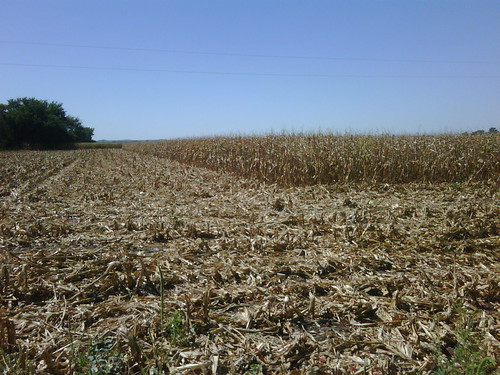
Here is a partially harvested field of corn. We are cutting non irrigated portion of the field, foreground. The irrigated portion in the background will be harvested at a later date.
Our irrigated corn is longer maturity, planted a few days later, and had water when the planted needed it the most so it matures slower. Corn has an amazing ability to maintain grain quality and not fall down while standing in the field so it might not be harvested until November after soybean harvest and wheat seeding. Much of our irrigated corn will be stored on the farm and sold later to either the "neighborhood" feedlot, one of the feedlots within 100 miles of the farm, or an elevator that might blend higher quality with lower quality corn and will most likely sell it to a feedlot or ethanol plant. The demand for corn in my part of Kansas is higher than the supply which allows us to take advantage of good prices.
This old girl is the combine that we harvest corn with.
We have started harvesting our non irrigated corn this past week. Most of the corn goes to our local "neighborhood" cattle feedlot. We sell some of our corn there directly from the field and they are very competitive on the price they pay for corn. They use corn everyday as a part of the feed ration to cattle, so they can take some corn that is too high in moisture for long term storage. When the moisture inside the kernel of corn is above 15% it will deteriorate over long storage periods and warm temperatures speed up the process.
Here is a partially harvested field of corn. We are cutting non irrigated portion of the field, foreground. The irrigated portion in the background will be harvested at a later date.
Our irrigated corn is longer maturity, planted a few days later, and had water when the planted needed it the most so it matures slower. Corn has an amazing ability to maintain grain quality and not fall down while standing in the field so it might not be harvested until November after soybean harvest and wheat seeding. Much of our irrigated corn will be stored on the farm and sold later to either the "neighborhood" feedlot, one of the feedlots within 100 miles of the farm, or an elevator that might blend higher quality with lower quality corn and will most likely sell it to a feedlot or ethanol plant. The demand for corn in my part of Kansas is higher than the supply which allows us to take advantage of good prices.
Subscribe to:
Posts (Atom)