Thursday, February 2, 2012

To Cover Crop or not

Authors note: Much of this is my recap of the 2012 No Till on the Plains Winter Conference. I went into the conference wanting to wrap my mind around utilizing cover crops in no till better. I still have many questions, but they might be best answered from experimenting.

Implementing cover crops in no till cropping systems has been a concept introduced to me at the No Till on the Plains winter conference a couple of years ago. Cover crops are plants seeded and grown between cash crops. These plants can be legumes that takes nitrogen from the air for the plant to use, brassica's that are deep rooted that help break compacted layers of soil and trap nitrogen, or grasses that hold soil and take up nutrients.

Gabe Brown, North Dakota farmer and rancher, was the first farmer that really got me interested in this crazy idea. He had found that a complex blend of plant species with varying root depths not only survived, but thrived in through North Dakota droughts. In the initial presentation a few years ago he talked about grazing cow/calf pairs for a month on a cover crop blend, I think he estimated the weight gain on the calves generated $100 or more an acre, that really perked my interest. At his presentation this past winter we told of a corn crop planted in a cover crop blend of cereal rye, vetches, oil seed radishes, turnips and a variety of other plants species. His cost of production was $1.10/bu he made one herbicide application to terminate the rye and set back the vetch enough to not compete with the corn and the cover crop blends provided all the nutrients. The expenses for his cover crops were covered by grazing them with cattle. He showed pictures of a corn crop that was planted into some of the heaviest ground cover of I've ever seen, at around tassel stage the trash was very deteriorated, at harvest the space between the rows were bare with the exception of some vetch that looked about a foot tall, and a couple of weeks later the vetch really started growing.

So Gabe Brown had luck with his cover crops during North Dakota droughts, but how would they deal with a Kansas drought? Gail Fuller, east central Kansas and Ryan Speer, south central Kansas, each gave presentations about their use of cover crops in last summer's drought.

Fuller has had cover crops longer in his rotation and felt early in the season his corn had the potential to be some of his best ever. He showed pictures of it green where his neighbor's corn was burned up from the drought, but relief from the drought came too late for it. After harvesting as forage he planted cover crop blends back to it to protect the soil and keep soil ecology working. The cover crops looked like they had good growth in his photos.

Ryan Speer is transitioning cover crops to his crop rotation and has experimented some the past few years. Speer's dryland corn was horrible, I think he said it yielded in the 15 to 20 bushel per acre range this year, but he noticed his yield monitor jumped up to 60 to 70 bushel range in a spot where there had been a plot of sun hemp between wheat crops three years ago. He stated that evaporation in the fairly short fallow period, late June to early October, is more than the water requirements of many of the cover crops. Speer has also been having rye and radishes flown on to irrigated corn fields late in the irrigation season. These are some very sandy field and he's seen an increase in soil organic matter to help increase both the water holding capacity and fertility of these fields.

So how do I tell how much nutrients are these cover crops are either tying up to be released when they decompose or nitrogen they are "making" in the case of legumes? Ray Ward of Ward Lab, recommends farmers either estimate how many tons of hay the cover crop may make and determine protein value of the various plants or send a vegetative sample from one square yard for a cover crop analysis. Many cover crop advocates emphasizing some very diverse mixes so I feel sending a sample would be more helpful.

How do cover crops effect soil biology? Dr. Jill Clapperton soil biologist and president of Rhizoterra Inc explained that poor soil biology produced poor crops in terms of both crop yields and nutrient content. She went on to tell us that most soil organisms are fed by the soil organic matter and when cover crops are used there are more actively growing roots throughout the entire growing season to keep producing soil organic matter. She also stated that the more diverse mix of plants that are growing on top of the soil the more diversity in soil organisms, since a monocropping system is used for cash crops this leaves cover crops to be a major source of plant diversity. Earth worms are one of the biggest and easiest to recognize soil organisms and they absolutely dislike soils that have had mechanical tillage performed. Mechanical tillage disrupts the soil organisms that earth worms live on.

Fuller commented on having part of a field that was poor even though soil tests revealed that fertility was the same as the rest of the field. A mycorrhizea test revealed that it was severely out of balance there. Clapperton mentioned that Ward Lab and a few others are capable of testing for it now. Determining which cover crops helps correct mycorrhizea problems is a challenge.

I sat in a presentation of Dr. Jonathan Lundgren an entomologist with USDA-ARS, stationed at North Central Agriculture Research Laboratory, Brookings, South Dakota. He does extensive research and studying of predator insects. He stressed that reducing soil disturbance and careful scouting and using insecticides only when thresholds are met are a help preserve insect predators. He felt cover crop blends are helpful in recruiting more predators insects to fields to reduce need for insecticides.

I ran into a neighbor, Craig Ballou, he had a stop on a sunflower crop tour last summer at a double crop sunflower field without commercial nitrogen fertilizer. The field had been in a sun hemp cover crop between two wheat crops. It's a common practice of no till farmers in my area to raise two continuous crops of wheat. From past soil tests on double crop sunflowers in this rotation the nitrogen left was the same as what he had applied so he decided to not apply it. With our winter wheat growing season the soil doesn't warm soon enough for the residual nitrogen from a legume to be available for the wheat other than a possible protein boost.
Sunflower Showcase 3
Here are Craig Ballou's double crop sunflowers on August 30th. No nitrogen fertilizer was applied and Craig said they did very good, I could tell he was proud of them when I asked him about them.

I feel transitioning to cover crops is the next step in our no till rotation. I feel it will be a fairly slow transition as we learn what mix of plants and how to seed them in a timely manner. We will need to start on land we own, partially to insure we receive the long term benefits of it and to also prove to landlords that this crazy idea is viable.

Sunday, August 28, 2011

August update from down on the farm

In my area, north of I70 in central Kansas many of the crops look good, the corn will be disappointing due the heat and drought conditions in July. Sorghum and soybeans look good thanks to timely rains in early August. My understanding that the area south of I70 is still in drought conditions.

Heat stress corn
Two ears of corn from the same field. The ear on the left is very nice but you can see where that heat affected the pollination. The ear on the right was on the edge of getting irrigation water, so it had water in addition to heat stress. There are ears like both of these scattered through the field, but more like the one on the left than the one on the right.


grain sorghum b '11

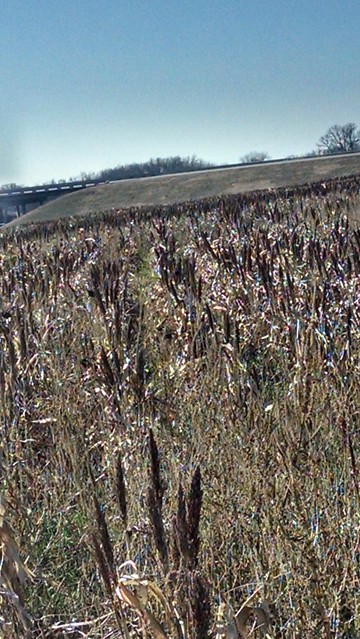
grain sorghum a '11
A couple of picture of our grain sorghum. It's headed out very nice and thanks to timely rains the past few weeks it has tremendous potential. Being a crop that originated from Africa it handles the heat well. In fact it thrives on the heat that is common in July and August. From my experience in dry years we will receive August rains, in addition to soil water savings from seeding directly into last year's wheat stubble that is timely for sorghum production.

I haven't taken a picture of our soybeans but they have the potential for having a nice crop also.

Monday, July 25, 2011

News from the Good Old Days

I came across this in last week's, July 21, 2011, Minneapolis Messenger's. The Wells News column has a segment titled News from the good old days. They reprint local news stories from the 1930's. With the drought conditions in the southern plains that are reaching into many areas of Kansas in addition to the heat wave we're currently enduring this article about the local wheat harvest in 1937 perked my interest.

Originally published July 1, 1937 on the front page of the Minneapolis Messenger. "Elevators Are Making Record Runs - Wheat is pouring into the market as fast as it can be handled. While Ottawa County was expecting a good crop, no one was expecting as big as a crop as in evidence already. In the eastern part of the state the yield proved a big disappointment. Black rust seems to be the cause of smaller yields. Wheat was bringing $1.03 a bushel and Wednesday morning it was bringing $1.10 a bushel. (1935 and 36 were very dry years and very little wheat was raised. Some brave farmers planted in the fall not knowing if they would get a crop.)" Currently wheat is selling for $7.45 a bushel, it wasn't very many years ago that $4.00 a bushel was considered a very good price.

I'm interested in how the depression and dust bowl effected my local area. My granddad grew up in this era and has passed on a few stories to me about it.While he is still around I need to record more of his stories of farm life in the 30's and 40's.

Heat wave

We are in the grips of the heat wave that is sweeping most of the nation. It's hard on everything outside. Our corn is in the high water use growth stage, it's using .40 inches of water use a day. It can be a challenge keeping irrigation running. Engines that run the pumps and generators can overheat and shut off, we have gauges that will shut off the engines before they're damaged. Our low humidity is increasing the evaporation even with drop nozzles that put water into the corn's canopy.

drought corn
This is a corn field that has either been put up as hay or chopped for silage. The brown strips are corn that has been left for insurance adjustors to verify loss. Normally the corn would still be green rather than brown. This field is only 80 miles from where we farm.

The corn yields are being hampered by the high temperatures even with adequate water. During pollination the pollen is damaged from the high heat and reduces the kernels that will be on each ear of corn. With temperatures in the low 90's at midnight it's hard for corn to release the water it used earlier in the day to transport nutrients from the soil, this also hampers yields.

Our irrigated soybeans need .30 inches of water a day, but they are getting sacrificed some right now to keep the water on the corn. They are a very resilient crop and if we can get some rain soon they will be fine, the more critical time for them to have water will be in a few weeks when they start setting and filling pods. So there is still time to water them to make a respectable yield.

On a drought tour of extreme southwest Kansas Governor Brownback he was quoted in the news saying. “There’s been less rainfall this year than in the peak of the 1930s Dust Bowl with the same heat and wind. Hats off to the producers for being such good stewards.” This shows just how extreme the drought is in the south western portion of the state. It is also a testament to farming practices that have been implementing since then, we no longer bury the stubble leaving bare soil vulnerable to wind.

Sunday, July 24, 2011

Report from the farm

Things have been mighty hectic down on the farm since the last time I took time to write. All the spring seeded crops are in, wheat harvest went pretty smooth, and I was able to plant 300 acres of sunflowers in wheat stubble. We did have a hail storm move through at the beginning of wheat harvest, it stripped the leaves off of the corn and knocked wheat out of the heads. Our non irrigated corn which is planted earlier still shows signs of stripped leaves, but the irrigated corn that was still going through a growth spurt and has nice healthy leaves.

Hailed corn
This was taken the day after the hail storm. This field had the least damage done to it, but it was still sickening to look at it that morning.

Our wheat yields were average to slightly better. Quality was high, both test weight and protein content was high this year. The standardized weight for wheat is 60 pounds a bushel for number 1 wheat, nearly every load of our wheat had a test weight of 6o or better with many loads 61.5 or better. The protein content of our wheat ranged from 10.5% to 12% with most of it in the 11% range. This is a very good protein content for our region, in the lower rainfall areas of western Kansas.

pre wheat harvest 11
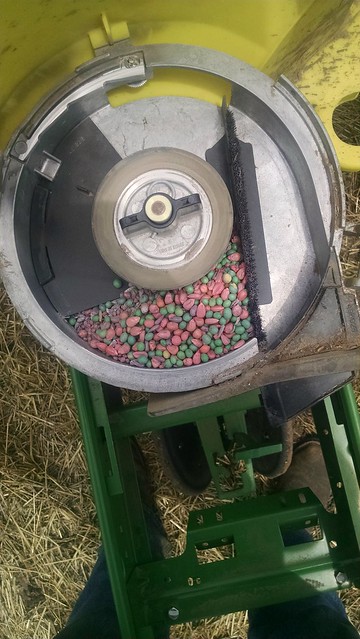
I took this right before wheat harvest. The darker stripes are a different variety of wheat. I had just a little bit left in the seeder and it mixed with the other seed.

wheat harvest 11e
This is the same field at harvest, facing a different direction in this photo. Dad is cutting the terraces, terraces are ridges put made in fields to redirect water to reduce soil erosion. The headers, the part on the front that cuts off the crop, doesn't flex so we have to harvest with the terraces.

I've added various pictures and descriptions to my Flickr account. My photos that I use from my blog are there along with many that I haven't used. The photos range from basic information to more technical issues.

Wednesday, May 25, 2011

Spring '11 update

We've been through some extreme weather the past month. There were records set for high temperatures and then records were set for low high temperatures a few days later. When we started planting corn in early April we had idea soil moisture, but after a few hot and windy days the top soil dried out for proper seed germination on our irrigated land and required an irrigation application, except for one field that had raised wheat and then had a sunflower crop on it last year. Wheat stubble served as a blanket to protect the soil from the wind and hot temperatures that helped dry out the other fields. The dry conditions extended into soybean planting up to last week, knowing there was a strong chance of rain for multiple days in the forecast and field conditions were favorable I planted late into the night on both Monday and Tuesday night. From Wednesday through Friday we had up to 4 inches of rain. On this past Monday I was able to resume planting soybeans and Tuesday I had enough time to load the planter with seed before it rained again. We have about 300 acres of soybeans left to seed, which should take about 3.5 days including moving the tractor and planter half way across the county.

One of the rainy day projects was selecting a bull for the cow herd. My youngest son and I traveled to Wolf Creek Angus Ranch to look over their selection of bulls. We got there just as a storm was starting to bear down so we sat in their office looking over the performance data on thier remaining bulls and visited. After the storm ended we walked through the bulls and made the selection. Shortly after leaving the ranch I noticed water running off of fields and filling ditches, I was surprised because they only had 1/4 inch of rain at the ranch. About half way home we drove into a driving rain where we could barely see the road so we pulled into a tractor dealership at a little town, little man only gets excited over John Deere equipment and this wasn't a Deere dealership.

These rains and cooler temperatures will help our wheat fill. Our later seeded wheat will benefit the most, which appears to be a week or so later in maturity even though it may have been seeded several weeks later.

Today I discovered these videos from King Arthur Flour. We are grower owners of a cooperative flour mill that sells hard white wheat flour to King Arthur Flour. We're proud to work with a group of people such as King Arthur Flour that are as passionate about the flour they sell as we are about the wheat we raise.


Monday, April 25, 2011

Rural Volunteer First Responders

Saturday night while driving home after taking our kids to a movie in a nearby town we saw a motorcycle stopped in the middle of the road and what we first thought was a road kill deer on the side of the road. When we got closer the motorcycle was laying on it's side and what I thought was a dead deer was the rider laying on the edge of the road. He had hit a deer and laid his Harley down.

I walked up to him quickly with my phone in my hand, not knowing what to expect. He was alert and I asked if he had called 911 yet and he told me they had been contacted. With it being a calm night and close to town I heard the sirens for the volunteer fire department going off, I reassured him that help would be there shortly and the best thing for him to do was to just lay there.

The firemen pulled up and jumped out and started evaluating him before the ambulance was there. All the firemen are men are from the community that have other jobs, one of them is the county sheriff, a couple are mechanics, and I didn't know the others. These men give their time to help ensure the safety of our rural communities, they might get some compensation when they're on a call or at training, but not enough for the time gone from their jobs or family or the danger they put themselves in.